
06 May The AI Diary: The Jevons Trap
May 6, 2026
If you believe that making AI cheaper will automatically solve the industry’s biggest problems, there is a 160-year-old story that says otherwise.
In 1865, an English economist named William Stanley Jevons looked at coal consumption in the age of steam engines. The logic of the time was simple: more efficient engines should burn less coal, so total coal usage should go down.
It didn’t.
As steam engines became more efficient, they became more useful. They powered more factories, more ships, more trains, and more mines. Demand for coal didn’t shrink — it exploded.
Making something cheaper and more efficient did not reduce consumption. It increased it. That pattern became known as the Jevons paradox.
Today, we are watching the same paradox play out in artificial intelligence.
We can depict this in a simple chart.
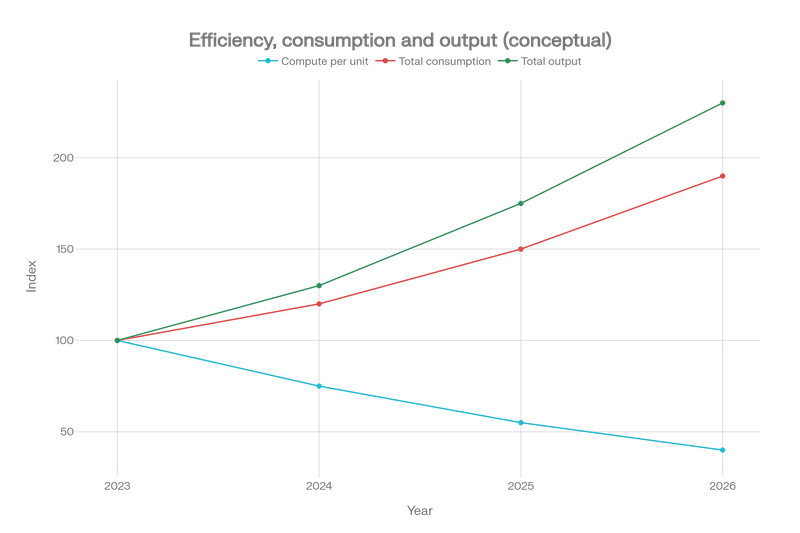
As the cost of computational power decreases (the blue line), the opportunities AI offers increase. As a result, total consumption of computational power also rises (the red line), which in turn leads to an increase in the total amount of goods produced (the green line).
What This Means for Business Founders
If you are building products on top of AI, this paradox is not an abstract thing. It directly affects how you should think about your product, pricing, and infrastructure.
- Cheaper is not safer. When you reduce the cost of your AI features, because the cost of AI goes down, you may trigger a usage spike that can break your infrastructure, your margins, or both. Lower prices move the bottleneck from “can users afford it?” to “can you serve it?”
- Unlimited is a trap. “Unlimited” plans look attractive in marketing, but in an AI world, they can turn into a Jevons trap: the more powerful and cheaper your tool becomes, the more your heaviest users will stress your system.
So, this represents a new mental model for building software solutions on top of AI:
Cheaper and More Effective → More Usage → New Bottlenecks
Designing Around the Jevons Paradox
In an AI‑driven business, a flat “all you can eat” price is dangerous: sooner or later your best customers will push your system to its limits, burn huge amounts of compute, and quietly destroy your margins. Instead of treating AI as a fixed‑cost feature, design your product so that the more your customers use it the more they pay.