
10 Dec The AI Diary: Upcoming AI Trends
Dec 10, 2025
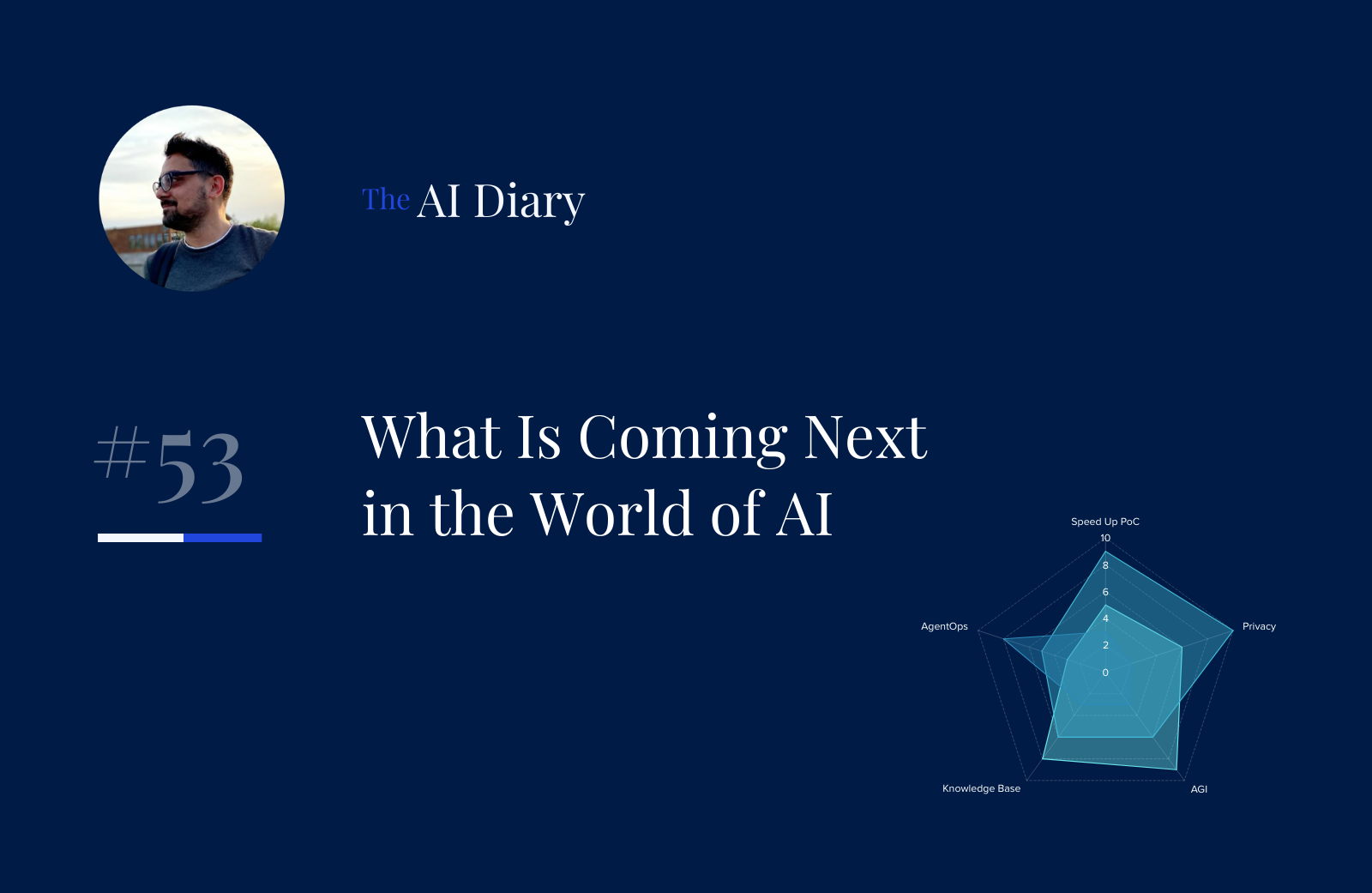
Today, I will talk about five tendencies we will see in the world of AI, business, and software development in the next few months. I intentionally avoid using the word “years” because predicting the future that far ahead is not easy.
Automation via AI Agents
All business processes that involve following routine procedures to achieve a final result will be automated. These are processes that follow an algorithmic, step-by-step approach where the level of randomness is very low or even zero.
Because such processes can be described as a set of rules with almost no unpredictability, they can be automated through software code and AI models, allowing them to run automatically.
The main outcome will be time savings for employees, who, instead of spending hours or days on repetitive work, can focus on more essential and creative tasks.
It is important to note that this automation is not necessarily cheaper than performing the job manually, but it will almost certainly save time. The reason it may not be cheaper is that AI models require computational power and energy to process data and solve the tasks being automated. This process comes with its own cost.
Privacy
Many companies are in a rush to integrate AI solutions into their workflows, with the ultimate goal of achieving competitive advantage. However, to do that, they often have to rely heavily on cloud-based LLMs (Large Language Models) provided by OpenAI, Google, and others. These big companies claim that they do not use your data for their own benefit or to train future models, and in fact, when you use the OpenAI API, there is an option to explicitly state that you do not want your data to be used in this way.
Let me ask one simple question: Do you believe that another company that has full access to your data will not use it to benefit from it and gain an even greater competitive advantage?
I do not know about you, but my answer would be simple: no, I do not trust them.

This is why one of the next tendencies in the AI world will be companies implementing in-house AI solutions with their own hardware and software infrastructure, isolating their data from the outside world. Running private or on-premise AI helps organizations keep sensitive data within their own perimeter, which is why privacy will be the key driver for this shift.
Knowledge Base
Do you know that AI models are limited in terms of the amount of information they can work with? This is called the context window. Let me give an example: if you give ChatGPT 10 files with 1,000 pages each, the chances of the AI getting confused or forgetting half of this information are very high.
As a result, whatever you ask the AI model, it may give an inaccurate or wrong answer. It is similar to a human who has to know 10,000 pages of information by heart. This is simply not possible, at least for now.
Of course, this explanation oversimplifies the problem, but you get the point. AI models cannot handle a huge amount of information at once because that would degrade their performance. They perform best when you give them small chunks of information and ask them to perform relatively simple tasks.
Therefore, a question pops up: How can you build an AI system capable of working with a huge knowledge base and giving you accurate and helpful results at the same time? There are solutions to this problem, and there are already companies working on them.
My prediction is that these types of services will appear more and more, simply because they will make AI solutions even more powerful in solving complex problems.
Speed Up PoC Development
Most probably, you are familiar with platforms like Replit or Lovable. These platforms essentially allow you to build proof-of-concept products that are ready for release to test market demand by simply giving the AI model a specification of requirements, such as designs and what the software platform should do.
Personally, as of writing this article in December 2025, platforms like Replit and Lovable are still far from achieving this with consistently high quality, but they will get there. It is only a matter of time.
Business requires validation of hypotheses much faster and cheaper. Nobody objects to deploying a software product more quickly and at a lower cost in order to test a business idea before committing to full-scale development with software engineers.
Therefore, platforms like Replit and Lovable, including private in-house solutions, will appear more and more on the market.
AgentOps
For the automation of business processes, the implementation of in-house solutions for companies, and the development of platforms like Replit, a new branch of specialists will become increasingly popular: AgentOps. These are professionals who focus on setting up AI agents and the supporting infrastructure that involves AI models.
This is one of the new types of jobs that has actually emerged with the rise of AI.